
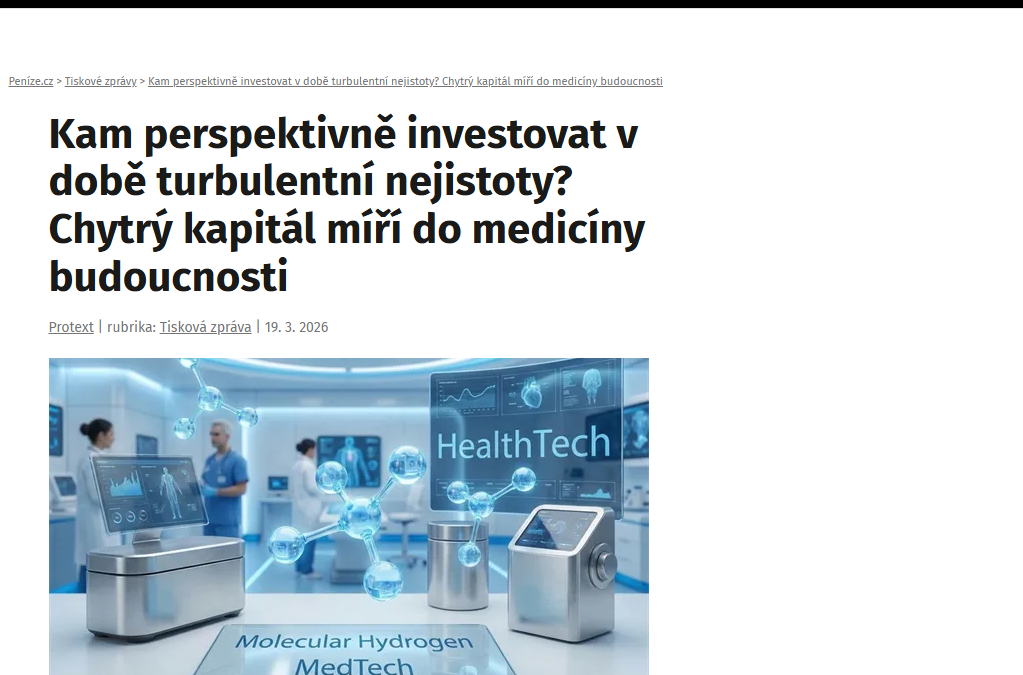
The world has entered a period of turbulence. Geopolitical and trade instability, pressure on healthcare systems, and an aging population are changing the rules of the game. Investors are no longer just looking for growth. They are looking for sectors that will be essential regardless of geopolitics, economic cycles, or market sentiment. And one of the strongest investment sectors today is MedTech – the medical technologies of the future.
The world has changed. And with it, the rules of investing.
The pressure on healthcare systems and the aging population show that a period is coming in which investors can no longer rely on traditional schemes. Looking for growth is not enough. It is necessary to look for resilience, social necessity, and fields that the world will need regardless of geopolitics, the economic cycle, or market sentiment.
That is precisely why more and more capital is starting to shift towards MedTech – the healthcare technologies of the future. It is a segment where social responsibility is exceptionally strongly combined with investment attractiveness. Health is not a trend. It is a certainty. And in turbulent times, even more so than ever before.
Treatment and Prevention as the New Safe Haven for Capital
Every period of uncertainty reveals what is truly indispensable to society: food, energy, water, and healthcare. However, healthcare itself is currently undergoing a fundamental transformation. Simply having more doctors, more hospitals, or more traditional care is no longer enough. The system is under pressure and will increasingly depend on technologies that can accelerate, streamline, and expand treatment, offering new possibilities where old approaches are no longer sufficient. At the same time, the importance of self-care, prevention, and personal responsibility for health outside the healthcare system itself will grow. The technologies of the future will not only play a role in hospitals and clinics but increasingly in people’s daily lives—through early intervention, support for regeneration, long-term care for cognitive and physical fitness, and reducing the pressure on an overburdened healthcare sector.
This is exactly why MedTech is ceasing to be a niche field and is becoming one of the most interesting investment themes of our time.
The European medical technology market is valued at approximately 170 billion euros, with over 38,000 companies operating within it, more than 90% of which are small and medium-sized enterprises (SMEs). In 2024 alone, more than 15,700 patent applications were filed in the sector. This is not a small segment for a few specialists. It is a strong innovation ecosystem where long-term value is created.
The United States sends an even stronger signal. The American medical technology market accounts for approximately 46% of global medical device sales, and it is there that the true value of successful medical innovation becomes apparent the fastest.
Billion-Dollar Deals Confirm MedTech is a Big Game
Today, investors only need to look at current transactions. Johnson & Johnson acquired Shockwave Medical for approximately $13.1 billion. Stryker took over Inari Medical for around $4.9 billion. Boston Scientific bought Axonics for $3.7 billion, Thermo Fisher acquired Olink for roughly $3.1 billion, and Zimmer Biomet bought Paragon 28 for about $1.2 billion. And there are many other similar transactions.
These numbers clearly show one thing: once a patent, clinical validation, regulatory clearance, and international growth potential are combined, assets are created for which strategic players pay billions. MedTech is no longer just the industry of the future. It is a market where big money is already moving today.
The Czech and Central European Markets Are Also Sending Strong Signals
The same trend is becoming increasingly visible in Central Europe. The Czech market no longer just creates startups without products. On the contrary: companies with certification, clinical relevance, international ambition, and real investment logic are emerging.
An example is Stimvia from Ostrava, which is developing neuromodulation technology and, after obtaining MDR (Medical Device Regulation) certification, is openly communicating its entry into the US with its URIS® system. The company works with the premise that for the diagnosis of overactive bladder alone, the direct and indirect costs of treatment in the EU and the US combined exceed $117 billion annually. This is exactly the type of market that interests investors: a large, expensive problem that has long been addressed inefficiently.
Another highly successful story is VR LIFE, whose product VR Vitalis Pro is an MDR-certified medical device for rehabilitation and neurorehabilitation in virtual reality. The company has already deployed its solution in healthcare facilities in the Czech Republic, Slovakia, Poland, and Ukraine. This means only one thing: it is not just an idea, but a real product with clinical and market application.
And it is right here that the investor story associated with H2 Investment, a company from the H2 Global Group, is very interesting.
The story of VR LIFE shows how quickly value is created in MedTech. H2 Investment entered the company in 2023 with an amount of 15 million CZK for a 20% stake. After an investment round in February 2026, the diluted share decreased to 18.26%, but according to the group’s materials, its value increased to approximately 1.278 million EUR, or about 31.2 million CZK. Even without an exit, the value of the investment grew by roughly 16.2 million CZK, or 108%. A model scenario is even more striking: if VR LIFE were to reach its planned valuation of 100 million EUR within a few years, H2 Investment’s stake would be worth approximately 18.26 million EUR, or about 446.2 million CZK. The original 15 million CZK would thus become a value higher by approximately 431.2 million CZK, representing an appreciation of around 2875%.
Czech HealthTech has already set a strong precedent. The uLékaře.cz project, co-founded by Tomáš Šebek, acquired a strategic buyer in the form of the Austrian healthcare group Mavie. Publicly available information speaks of a transaction worth upper hundreds of millions of crowns. This too is an important signal: Czech healthcare companies are starting to become attractive not only to domestic investors but also to foreign strategic partners.
Why H2 Global Group is Taking Center Stage
It is precisely in this light that H2 Global Group must be viewed. Not as just another startup story, but as a company entering MedTech at a time when the market already knows exactly what value patent-protected medical technology with clinical and regulatory progress can hold.
Building on over 19 years of research and development, H2 Global Group relies on the European patent EP 3701956 and, in January 2026, following approval by the State Institute for Drug Control (SÚKL), launched a clinical study through its subsidiary H2 Medical Technologies. Simultaneously, it entered the registration phase for the world’s first medical device utilizing molecular hydrogen. With a current pre-money valuation of 1.6 billion CZK, the company operates with the ambition of becoming an acquisition target for a strong international strategic partner within three years, with a potential transaction ranging from $0.5 to $1.5 billion, i.e., approximately 11.5 to 34.5 billion CZK. In other words: the company is aiming for a value corresponding to roughly 7 to 22 times its current valuation.
The reason why such an ambition may not be unrealistic is clear: today, the potential of molecular hydrogen is backed by more than 3,000 scientific publications and studies, including over 150 human studies, and H2 Global Group is simultaneously building not only a specific product but also a broader technological platform for the medicine of the future. The moment a patent, clinical results, registration, and international commercialization are combined, the company can move into the category of the most sought-after MedTech assets within a few years. In this segment, you don’t just pay for a finished product; you pay for a technological head start that is faster and cheaper to buy than to build from scratch. This is exactly why similar solutions at this stage are often sold to strategic players. The reason is not only capital appreciation but also the ability to accelerate registration, production, distribution, and entry into other global markets. Ultimately, it is often only a strong international partner that can transform a technological head start into global availability, bringing innovative solutions to a significantly larger number of patients they can genuinely help.
Capital is Already Shifting. The Question is, Who Will Be There
Today’s world is tougher, faster, less predictable, and significantly more demanding than it was a few years ago. But precisely such times also reveal which sectors carry real weight.
MedTech is one of them.
Billion-dollar transactions in the US, a robust European market, a growing number of patents, strong examples from Central Europe, and new Czech companies with clinical and technological ambitions all show one thing: capital is already starting to shift into the medicine of the future in a big way.
For investors who want more than just traditional sectors in their portfolio, this is a signal they shouldn’t ignore.
Because in turbulent times, the greatest value is not created where there is merely demand.
The greatest value is created where demand is inevitable.
And that is exactly why MedTech is becoming one of the strongest and most desirable investment themes of the coming years.
www.H2times.news www.MolekularniVodik.cz www.H2invest.cz
Author of the Article David Maršálek
Editor-in-Chief of H2 Times News, the first hydrogen newspaper, and also CEO and Founder of H2 Global Group.
About the Author
David Maršálek is the founder and owner of H2 Global Group, which focuses on the development, clinical validation, and international scaling of healthcare technologies based on the use of molecular hydrogen, as well as connecting capital with innovations in the fields of MedTech, HealthTech, Longevity, and long-term care. Under his leadership, the group acquired unique patent solutions from Japan, established cooperation with a top Japanese research team, built a technological and scientific base with a global reach, and achieved an announced pre-money valuation of 1.6 billion CZK. In January 2026, H2 Global Group launched a clinical study approved by SÚKL and simultaneously entered the registration phase for the world’s first medical device utilizing molecular hydrogen in the field of neurodegenerative diseases.