
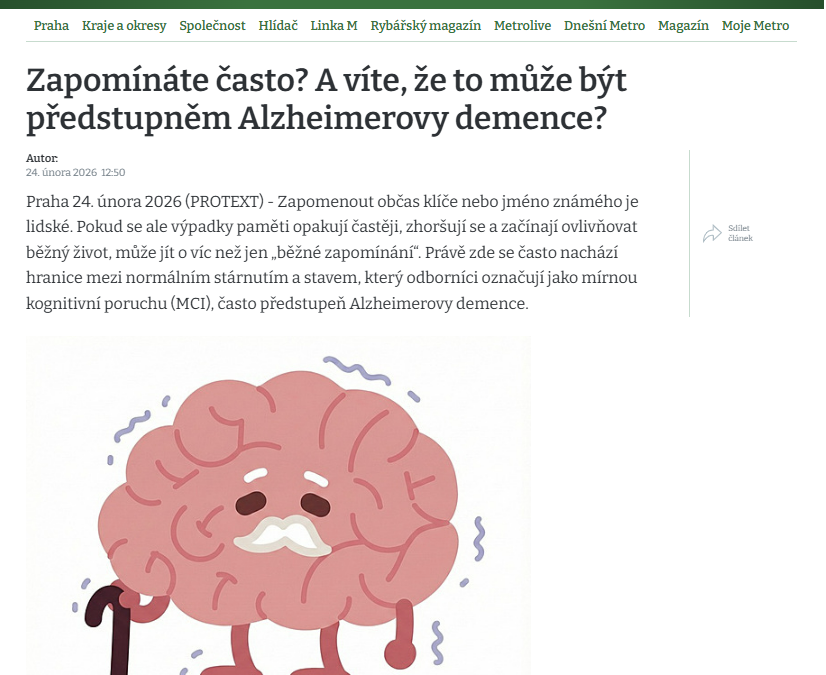
Forgetting your keys or an acquaintance’s name from time to time is human. However, if memory lapses occur more frequently, worsen, and begin to affect your daily life, it might be more than just “normal forgetting.” This is often where the boundary lies between normal aging and a condition experts call Mild Cognitive Impairment (MCI), which is frequently a precursor to Alzheimer’s dementia.
What is still normal forgetting, and what is not?
The brain changes as we age. Information retrieval slows down, and it takes us longer to recall names or specific words. This is natural. But warning signs look different:
-
Repeatedly asking the same questions
-
Getting lost in familiar places
-
Difficulty with planning and organization
-
Changes in personality or judgment
-
Problems with common daily activities
If these symptoms persist, it could indicate early-stage cognitive impairment.
MCI: The Silent Precursor to Dementia
Mild Cognitive Impairment (MCI) represents an intermediate stage between normal, trouble-free aging and dementia.
People with MCI already experience a measurable decline in memory or other cognitive functions, but they can still maintain relative independence. Not every case of MCI inevitably leads to dementia, but the risk is significantly higher.
Scientific studies indicate that a certain proportion of patients with MCI will develop Alzheimer’s disease or another type of dementia within a few short years. That is exactly why early recognition is crucial.
How does dementia develop?
Dementia is not a single disease, but an umbrella term for a group of conditions that lead to the gradual loss of brain cells. In Alzheimer’s disease, the following occurs:
-
Accumulation of pathological proteins (amyloid beta and tau protein)
-
Damage to the connections between neurons (synapses)
-
Gradual death of brain cells
-
Shrinking of certain brain areas (especially the hippocampus—the memory center)
This process often begins many years before the first symptoms appear. This means that by the time significant memory issues arise, the disease may already be well advanced.
Why is early action important?
Early diagnosis allows for:
-
Slowing progression through appropriate therapy
-
Lifestyle adjustments (sleep, sufficient exercise, a nutritionally rich and balanced diet, mental activity)
-
Planning for future care
-
Involving family and support services
Breaking down the social stigma is also essential. We need to talk about cognitive disorders openly, without fear, and without prejudice.
Hope in Research and Innovations
Modern medicine is increasingly focusing on early detection and a preventive approach, followed by support for appropriate treatments. This exact idea is the foundation for the activities of the Czech company H2 Global Group, which has launched a globally unique study focused on innovative approaches to neurodegenerative diseases using molecular hydrogen.
The group’s founder, David Maršálek, has long emphasized that Alzheimer’s disease is not just an individual health problem, but a major societal challenge. Investments in research, prevention, and innovation are therefore not just a healthcare issue, but a matter of responsibility toward future generations.
Forgetting is not a weakness. It is a signal.
If you notice the aforementioned changes in yourself or your loved ones, do not ignore them. Consulting a general practitioner or neurologist can be a major turning point in your life.
Dementia does not start overnight. It often arrives silently, precisely during the MCI stage. And that is exactly when we have the greatest chance to actively influence our health. Because the sooner we act, the greater our hope of successfully maintaining a high-quality, fulfilling life for as long as possible.
Author: David Maršálek
About the author: David Maršálek is the founder and owner of the H2 Global Group, which focuses on the development, clinical validation, and international scaling of healthcare technologies based on the use of molecular hydrogen. He also bridges capital with innovations in MedTech, HealthTech, Longevity, and long-term care, including social services. Under his leadership, the group has acquired unique patent solutions from Japan, established cooperation with a top-tier Japanese research team, built a strong technological and scientific base with a global reach, and increased the company’s value to a pre-money valuation of CZK 1.6 billion.
In January 2026, H2 Global Group launched a clinical study approved by the State Institute for Drug Control (SÚKL) and simultaneously entered the registration phase for the world’s first medical device utilizing molecular hydrogen for neurodegenerative diseases. This was done with a clearly defined strategy to build the medicine of the future through a scalable technological platform that can be expanded into other areas of medicine. The group is thus moving into a phase considered a key value-creation point in MedTech, where clinical data and regulatory clearance typically lead to a leap in project valuation and increased interest from strategic partners. This is also why H2 Global Group is seeing growing interest from investors and entrepreneurs, both from the Czech Republic and abroad, who are looking to get involved in projects with global market potential and significant social impact.
David Maršálek has over 14 years of experience and expertise in molecular hydrogen and its practical applications in prevention for the general consumer public, as well as in the healthcare sector. He has built an international team of top experts—spanning from Japan through Europe to the USA—and his activities are geared toward future cooperation with global pharmaceutical and MedTech players. His goal is to introduce molecular hydrogen into regulated healthcare as part of “the medicine of the future” through a clinically and regulatorily anchored, scalable platform. This creates the prerequisites for strategic agreements and subsequent acquisition interest from globally operating companies that are already actively seeking similar platforms with a clearly defined clinical and regulatory trajectory and globally scalable potential.
Source: https://www.metro.cz/protext/zapominate-casto-a-vite-ze-to-muze-byt-predstupnem-alzheimerovy-demence.A260224_125000_metro-protext_air