
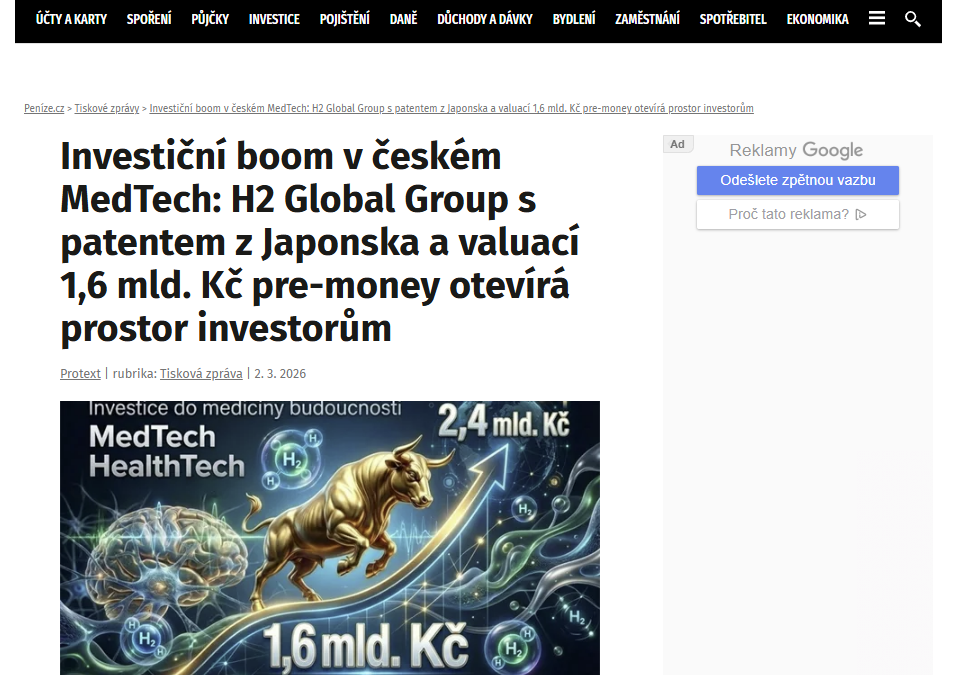
Czech start-ups are experiencing a significant investment boom, with an increasing share of capital flowing into medical projects. Investors are looking for technologies with global potential, strong intellectual property, clinical data, and a clear regulatory trajectory—factors that typically lead to a leap in valuation in MedTech. H2 Global Group, led by founder and CEO David Maršálek, is currently entering exactly this phase: the group is communicating a pre-money valuation of CZK 1.6 billion and is seeing growing interest from investors wanting to join the project.
MedTech is Back on Investors’ Radars
Healthcare innovations are among the most dynamic investment topics today. Global players in MedTech and HealthTech are actively seeking out the best technologies that are ready or close to market launch, not only through partnerships but also via equity investments and acquisition scenarios. This trend is also reflected in the Central European region, where clinically grounded platforms with international scalability are becoming targets for both investors and strategic partners, as they combine growth potential with significant societal impact.
H2 Global Group: From “Lower Hundreds of Millions” to CZK 1.6 Billion Pre-Money
Just a few years ago, the value of H2 Global Group hovered in the lower hundreds of millions of crowns. The turning point came when the group acquired and secured key intellectual property—namely the European patent EP 3701956 B1 “Prophylactic or therapeutic agent for dementia” from a Japanese research team led by Professor Shigeo Ohta—while simultaneously achieving regulatory and clinical milestones that are considered standard drivers for a leap in project valuation in the MedTech industry.
Video: https://www.youtube.com/watch?v=qgrEBbVWLdc
The patent describes the use of molecular hydrogen in the field of neurodegenerative diseases, including dementia, and is in the process of being expanded to other global territories. From an investment perspective, it is precisely this combination of a scientific foundation, patent protection, a regulatory plan, and clinical data that is crucial. Thanks to this combination, a “simple molecule” becomes a scalable technological platform that addresses not only economic but, more importantly, societal issues.
Another crucial step was the approval of a clinical study by the State Institute for Drug Control (SÚKL) and the transition into the clinical validation and registration phase of a medical device utilizing molecular hydrogen in the field of neurodegenerative diseases. It is the combination of securing patents, clinical trials, and subsequent regulatory steps that has led to the leap in valuation, as is customary in the MedTech sector.
Why Becoming Part of It Right Now Can Be Attractive for Investors
In MedTech, the largest portion of future value is often created when three elements converge: strong IP, clinical data, and regulatory feasibility. H2 Global Group is at this exact point: the clinical evaluation was announced as initiated in January 2026, and the project is simultaneously heading into the registration phase with the goal of registering the world’s first regulatory-approved medical device using molecular hydrogen.
For investors, this typically means:
- The opportunity to participate in the project before the full materialization of its clinical and regulatory value, i.e., at a time when the company’s value is typically much lower than it would be during a potential sale to a strategic partner.
- The chance to be part of a topic that is seeing growing demand not only from funds but also from strategic partners in the MedTech sector.
- The potential for future strategic agreements and acquisition scenarios, which are accelerating once again in the industry.
International “Appetite” for Unique Platform Solutions
From the perspective of global companies, it is crucial to acquire technology that is timeless, patent-protected, scalable, and regulatorily viable. It is precisely these types of projects that have become the subject of investments and acquisitions in recent years, as they accelerate the market introduction of innovations.
Evidence of this is the capital flow from strategic players in the MedTech space: for example, Johnson & Johnson acquired Shockwave Medical for approximately USD 13.1 billion, Novo Holdings took over Catalent for roughly USD 16.5 billion, and Siemens Healthineers acquired Varian Medical Systems for approximately USD 16.4 billion. Other frequently cited transactions include Philips and its purchase of BioTelemetry for roughly USD 2.8 billion or the acquisition of Abcam by Danaher for approximately USD 5.7 billion. This demonstrates that global players are actively purchasing technologies with clinical value, regulatory feasibility, and the potential for rapid scaling.
How Investors Can Get Involved
H2 Global Group is also targeting retail investors who want the opportunity to participate in a unique solution in the MedTech/HealthTech space. This opportunity is limited in both time and volume. Those interested in more information can write or call: David Konupčík, Director of Investor Relations Email: david.konupcik@H2invest.cz Tel.: +420 724 269 373, www.H2invest.cz, www.H2global.group, www.MolekularniVodik.cz
About the Author
David Maršálek is the founder and owner of H2 Global Group, which focuses on the development, clinical validation, and international scaling of medical technologies based on the use of molecular hydrogen, as well as connecting capital with innovations in MedTech, HealthTech, Longevity, and long-term care.
Under his leadership, the group acquired unique patent solutions from Japan, established cooperation with a top Japanese research team, built a technological and scientific base with a global reach, and increased the company’s value to a communicated pre-money valuation of CZK 1.6 billion. In January 2026, H2 Global Group launched a clinical study approved by SÚKL and simultaneously entered the registration phase for the world’s first medical device utilizing molecular hydrogen in the field of neurodegenerative diseases, with a clearly defined strategy of building the “medicine of the future” through a clinically and regulatorily grounded, scalable platform.
Source: H2 Global Group