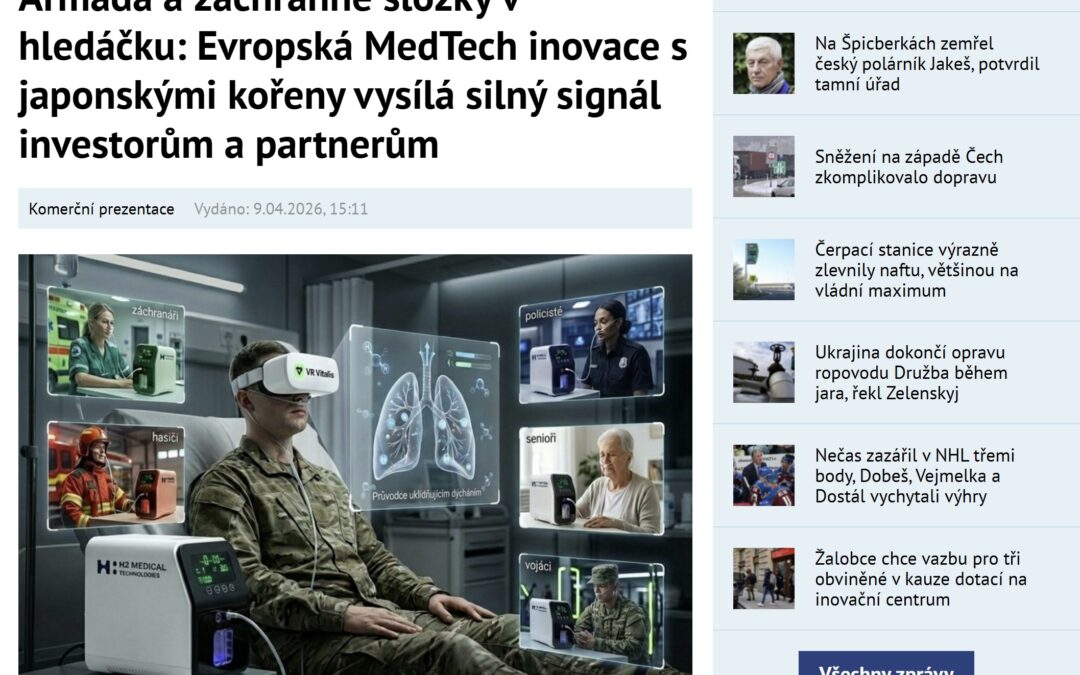
Military and emergency services in focus: European MedTech innovation with Japanese roots sends a strong signal to investors and partners.
The valuation growth of VR LIFE, strong clinical traction, and the upcoming entry into the US market are strengthening the strategy of H2 Global Group. Furthermore, the innovative platform, which combines Japanese research on molecular hydrogen and virtual reality, is seeing growing interest from the military and the integrated rescue system.
European MedTech innovator H2 Global Group is accelerating its expansion into the United States and global markets through its portfolio company, VR LIFE. The latter recently closed a seed funding round that more than doubled the value of H2 Global Group’s stake. In June 2023, the subsidiary H2 Investment acquired a 20% stake in VR LIFE for approximately 630,000 USD. In February 2026, VR LIFE closed a 650,000 USD seed round backed by institutional investors, increasing the implied value of H2 Investment’s diluted 18.26% stake to approximately 1.38 million USD. This milestone strengthens the group’s position to capture a larger share of the global medical device market, of which the US accounts for 46%, while simultaneously expanding its international distribution network.
“We are building a vertically integrated MedTech ecosystem that brings together breakthrough Japanese science, European clinical validation, and global capital to address the most pressing healthcare challenges of our time,” said David Maršálek, CEO and founder of H2 Global Group. “We are opening doors to US, European, and global investors, partners, and distributors who recognize this structural shift and want to capitalize on it.”
Japanese science, patents, and the world’s first H2 medical device
The foundation of the therapeutic platform is more than 19 years of deep research and development under the scientific leadership of H2 Global Group’s co-founder, Professor Shigeo Ohta, a world-renowned Japanese expert in molecular hydrogen science. The platform is protected by a portfolio of patents and utility models, most of which were developed by Professor Ohta and his team in Japan. H2 Global Group now holds the entire patent portfolio, which includes a patent for the use of molecular hydrogen in neurodegenerative diseases, including dementias, which is currently being expanded to other global markets, including the US.
Following approval by the State Institute for Drug Control (SÚKL), the subsidiary H2 Medical Technologies launched a clinical trial in January 2026 evaluating the safety of molecular hydrogen inhalation in patients with mild cognitive impairment (MCI), which often precedes Alzheimer’s dementia. Simultaneously, the company entered the registration phase for the world’s first medical device utilizing molecular hydrogen. The therapeutic potential of molecular hydrogen is supported by over 3,000 scientific publications and more than 150 human studies, with the company’s initial focus directed towards supporting the treatment and prevention of Alzheimer’s dementia, with possible expansion to type 2 diabetes, inflammatory eye and ear diseases, skin conditions, and wound healing support.
VR Vitalis: A certified medical device with the broadest portfolio on the market
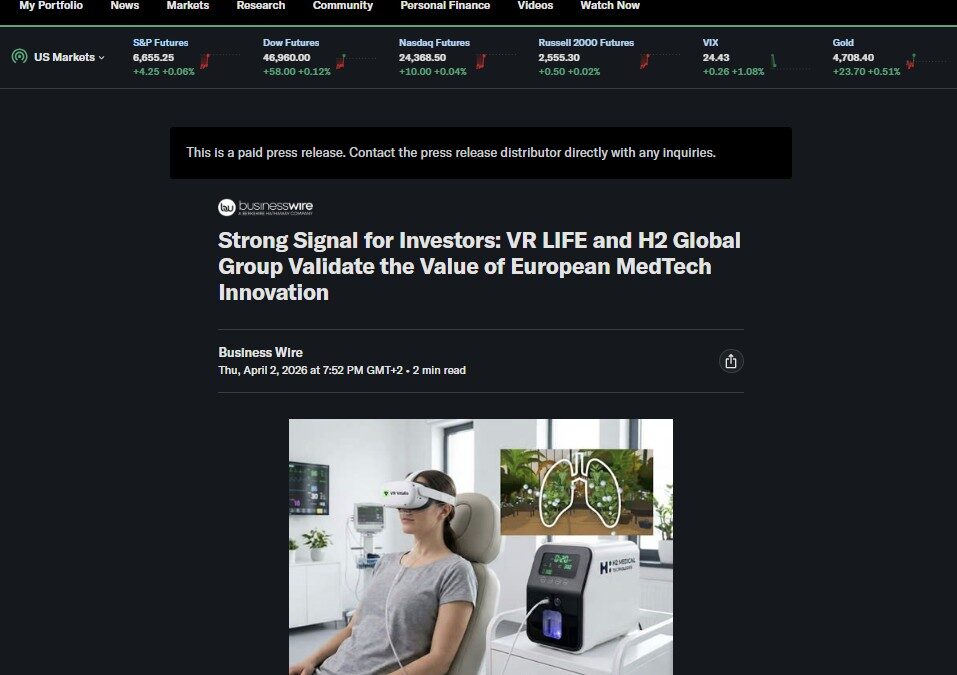
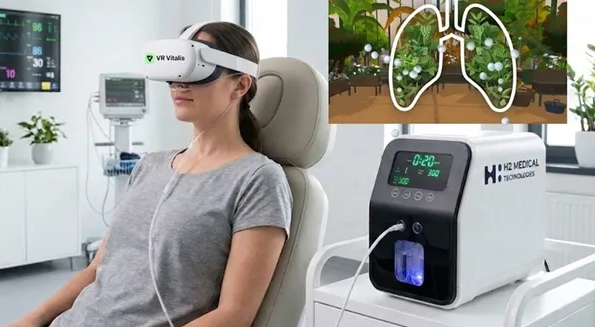
The second key component of the platform is VR Vitalis, a certified medical device (MDR) from VR LIFE, deployed in more than 40 hospitals across Europe, from university and regional hospitals in the Czech Republic, Poland, and Slovakia to a veterans’ hospital in Kremenchuk, Ukraine. This advanced hospital SaaS system stands out on the market with an unprecedented range of exercise modules covering seven key areas of rehabilitation: upper and lower limb exercises, back and neck, breathing exercises, cognitive training, fine motor skills, and relaxation. As one of the few systems in the world, it also offers specialized interactive exercises for the lower limbs. Thanks to flexible control with or without controllers (hand tracking), it is also suitable for patients with cognitive deficits or limited motor skills. Clinical results confirm a reduction in pain perception by 24–50%, an increase in motivation to exercise by up to 60%, and the ability for one therapist to treat three patients simultaneously, thereby fundamentally streamlining care in an overburdened healthcare system.
Growing interest from the military and emergency services
The synergy of molecular hydrogen and virtual reality opens up entirely new possibilities not only for the aging population but also for members of professions exposed to extreme strain. H2 Global Group has already registered preliminary interest from military procurement channels in Europe regarding the use of the platform for physical regeneration after combat deployment, support for the treatment of post-traumatic stress disorder (PTSD), and building mental resilience.
Statistics from 2025 show an alarming reality: one in seven frontline workers (14.3%) suffers from PTSD symptoms, 76% of career paramedics report chronic stress, and 45% of doctors show signs of burnout syndrome. In soldiers exposed to combat deployment, the PTSD rate exceeds 12%, a condition directly linked to massive oxidative stress and neuroinflammation.
While traditional psychological support does not address biochemical cellular damage, the H2 Global Group platform tends to act on both fronts. According to available scientific studies, molecular hydrogen acts as a selective antioxidant that promotes the protection of nerve cells and reduces the level of the stress hormone cortisol, while VR Vitalis provides immediate psychological relief, regulates breathing patterns, and shifts users from a state of stress activation to parasympathetic calm. The global veterans’ healthcare market exceeds 150 billion dollars, and the US Department of Veterans Affairs alone allocates over 115 billion dollars annually for direct medical care.
Expanded access for investors and strategic exit potential
To accelerate this dual commercial and clinical strategy, H2 Global Group has opened a strategic investment window ahead of upcoming clinical milestones. The initial offering for regional investors in the Czech Republic saw growing international demand, leading to expanded access for family offices, syndicates, as well as qualified individual investors seeking early exposure in the MedTech, HealthTech, longevity, and long-term care sectors.
With a current pre-money valuation of approximately 80 million USD, H2 Global Group aims to reach a transaction value of 500 million to 1.5 billion USD within a three-year horizon. This goal is backed by proprietary intellectual property, a growing international distribution network, and ongoing preparations for FDA certification in the United States. H2 Global Group is thus heading towards a strategic exit in the form of an acquisition by a major global player in medical technology or pharmaceuticals, representing a highly attractive value proposition for existing and future partners.
About H2 Global Group
H2 Global Group is a European technology group based in the Czech Republic, focused on the research, development, clinical validation, and international scaling of innovative medical technologies. The group specializes in the medical use of molecular hydrogen and in connecting smart capital with innovations in the MedTech, HealthTech, longevity, and long-term care sectors. By combining breakthrough Japanese biochemical science with digital technologies such as virtual reality, it creates comprehensive solutions for cognitive health, regeneration, and chronic stress management, ranging from households, nursing homes, rehabilitation centers, and hospitals to emergency services and the military.
www.H2global.group / www.H2invest.cz / www.H2medical.com
Source: H2 Global Group
ČTK Connect is releasing an image attachment with this report, which is available at https://www.protext.cz.